























- The operating model that built today’s telecom networks is no longer sufficient: complexity has outpaced human execution.
- Celfocus’s Executive Chairman Luis Salvado believes that the industry must shift from application-driven to intelligence-defined systems — or risk being outpaced by hyperscalers already treating networks as orchestrated software.

By Luis Salvado, Executive Chairman, Celfocus and CEO, Novabase.
I have spent most of my career working with data — long before it became fashionable.
In the early nineties, I was building business intelligence teams focused on turning data into decisions. At the time, the challenge was access: getting the data, structuring it, making it usable.
Today, the problem is different. Data is everywhere. What is missing is context — and the ability to act on it.
After four decades in technology and now leading a company deploying agentic AI inside live telecom networks, one thing is clear: the operating model that got us here is no longer enough.
Today’s telecom operators are more capable than ever. Networks carry more traffic, serve more devices, and underpin more of the global economy. Yet the operating model — applications, integrations, processes, and human-driven execution — has not kept pace with the complexity it now governs.
Modern telecom environments — spanning BSS, OSS, network domains, and customer platforms — are simply too complex to be efficiently operated through traditional approaches.
Large telecom networks can generate millions of alarms per day, with up to 90% being non-actionable or redundant. Multiple network domains, fragmented tooling, and distributed teams create limited visibility and poor coordination.
When something goes wrong, the process is familiar: parallel investigations, duplicated effort, and slow identification of the root cause. Operators are not managing networks as unified systems. They are reacting to fragmented symptoms.
Complexity has outpaced the model.
The stakes are too high to bet on the status quo
This complexity is not an operational inconvenience; it is a strategic liability.
The autonomous networks market is already worth close to $9bn and is projected to exceed $28bn by the end of the decade, growing at over 20% annually. This reflects a structural shift in how telecom infrastructure is built and operated.
Yet today, most operators are still below Level 3 on the 0-to-5 range of the TM Forum’s autonomy level framework, with only a few reaching higher levels at scale. As complexity increases, more effort is required to achieve the same outcomes. Scalability decreases. Responsiveness slows.
And the real competitive threat is changing.
It is no longer just other operators. It is hyperscalers and digital-native players that already treat the network as software to be orchestrated — not infrastructure to be manually operated.
A new operating model
What is changing is not just technology. It is the operating model itself.
For decades, telecom systems were defined by applications. Now, they are increasingly defined by intelligence — systems that understand context, make decisions, and execute actions across network and IT domains.
At Celfocus, we call this Next-Gen Intelligence.
It is not a product. It is a shift in how telecom systems are designed, operated, and governed. This shift can be understood in three movements:
- From application-defined systems to intelligence-defined systems.
- From human-driven execution to outcome-driven orchestration.
- From domain-based operations to cross-domain awareness.
And in practice, it comes down to three components:
- Data provides the foundation, with information aggregated and structured across domains to make it usable at scale.
- A digital twin provides context through a unified, real-time representation of the network that understands relationships between services, resources, and events, enabling the system to reason about impact and causation rather than merely report symptoms.
- Intelligent agents enable execution — monitoring, detecting anomalies, recommending actions, and increasingly carrying them out autonomously.
Without data, there is no intelligence. Without context, no decision. Without execution, no value. Value now lies in how operators structure data, model networks, design intelligence, and govern automated decisions.
This is not about replacing people. It is about changing what people do. Troubleshooting and manual correlation are being replaced by new responsibilities: defining logic, supervising intelligent systems, and governing decisions.
Less operation. More intelligence.
The future is already happening among Europe’s telecoms leaders
This path to transformation is not theoretical. It is already providing value.
Working with AWS and a leading UK operator, we are building the foundations for Level 4 autonomous network capabilities, aligned with a broader “Dark NOC” ambition. The solution uses AI agents, analytics pipelines, topology intelligence and automated root cause analysis (RCA) to monitor, correlate and explain cross‑domain network issues.
By distinguishing primary root causes from secondary symptoms, the platform is designed to reduce mean time to detect, diagnose and resolve incidents, while increasing operational trust and moving the network operations centre (NOC) towards a more predictive and autonomous operating model.
In Belgium, we are working with Telenet, implementing a network digital twin to enable cross-domain operations, and already achieving the following results:
- 90% of service impact assessments automated.
- Query time reduced from two hours to six minutes.
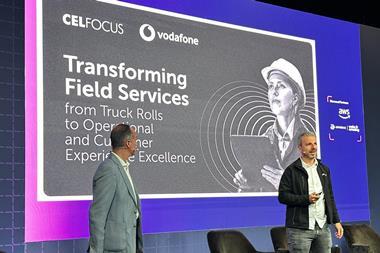
With Vodafone, our Cognitive Intelligence and Automation solution for the Global NOC has delivered:
- 90% improvement in mean time to detect.
- 70% reduction in event noise.
- More than 60 automated resolution journeys.
Equally important, operations teams have been retrained to work alongside AI — designing logic, refining models, and governing outcomes.
This is already happening. At scale.
Why Celfocus, and why now
Celfocus was founded 26 years ago at the intersection of data, engineering, and telecommunications — not as an adjacent technology vendor, but as a systems integrator embedded in some of the most complex, mission-critical environments our clients operate.
What we now call Next-Gen Intelligence is not a pivot for us. It is the natural evolution of a trajectory we have been on for decades.
Today, we operate in more than 25 countries, with offices in Cairo, Dubai, Dusseldorf, Heerlen, Lisbon, Newbury, Porto, and Riyadh, and we partner with five of the top six European telecom operators.
Our work is underpinned by strategic partnerships with leading hyperscalers — AWS, Google Cloud, Microsoft Azure — not as a reseller, but as a co-builder of intelligent systems at the network edge and across the operational stack.
Across Celfocus, this work is led by multidisciplinary teams combining deep telecoms expertise with advanced data and AI capabilities. The intelligence we deploy into networks starts with the intelligence of the people who design it.
Setting priorities for a seismic shift
The question for telecom leadership is no longer whether this shift will happen.
It is how quickly they can adapt — and what the cost of delay will be. Three priorities stand out:
- First, establish a real data foundation. Without contextualised, cross-domain data, intelligence does not work.
- Second, put governance in place before decisions are automated — not after.
- Third, invest seriously in the human transition: retrain teams to design, supervise, and govern intelligent systems.
Because governance is becoming the real differentiator.
As decision-making becomes automated, operators must ensure transparency, auditability, and alignment with strategic and regulatory requirements.
Final thought — a future guided by intelligence, not systems
The future of telecom will not be defined by the systems that operators run.
It will be defined by the intelligence that runs those systems — and by their ability to govern it. We spent decades building increasingly complex networks.
The next decade will be about making them intelligent — and learning how to trust and govern that intelligence.

Author bio
Luis Salvado is Executive Chairman of Celfocus and Chief Executive Officer of Novabase, listed on Euronext Lisbon.
With over 40 years of experience in the IT industry, he has played a leading role in technology-driven transformation across sectors, with a long-standing focus on data, analytics, and artificial intelligence. He began working in business intelligence in the early nineties, building and leading teams dedicated to data and digital innovation.
Today, his work centres on leadership, strategy, and the organisational impact of emerging technologies, particularly how AI is reshaping organisations, redefining work, and elevating uniquely human capabilities.
A frequent speaker and industry contributor, he has been recognised with the Best Leader Award in New Technologies.
Topics
- AI/GenAI/ML (artificial intelligence, agentic, machine learning)
- Automation
- Autonomous networks (zero-touch)
- AWS (Amazon Web Services)
- Belgium
- BSS/OSS
- Celfocus (Novabase)
- Data
- Data science (analytics)
- Digital twin
- DTW Ignite (TM Forum)
- Germany
- Google Cloud
- Hyperscalers vertical (webscale)
- Luis Salvado
- Network & Infrastructure
- Network Operations Centre (NOC)
- Operations
- Telenet
- Thought Leadership
- United Arab Emirates (UAE)
- United Kingdom (UK)
- Vodafone Group