





















- Mission to go global features heavily at annual Gamma Service Provider Forum, with midmarket business seen as ‘sweet spot’, particularly growing demand for overseas support.
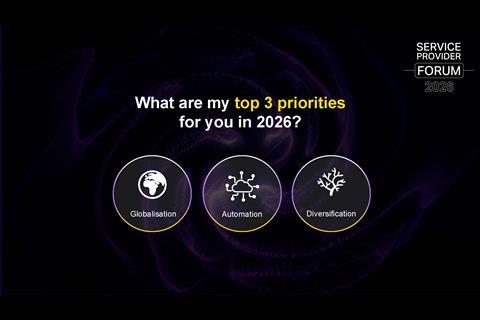
- Tracking four years of market evolution, Gamma sees SPs at an inflection point: ‘diversify, automate, globalise’.
- Gamma is adding major global localisation, reaching into high-growth, hard-to-access APAC in a bid to tap regional expansion opportunity for SP clients.
- Gamma is actively encouraging SPs to diversify their service portfolios.
- Industry analysts corroborate Gamma’s strategic direction, noting that enterprise demand for AI, enhanced data security, and integrated cloud communications will drive significant future revenue.
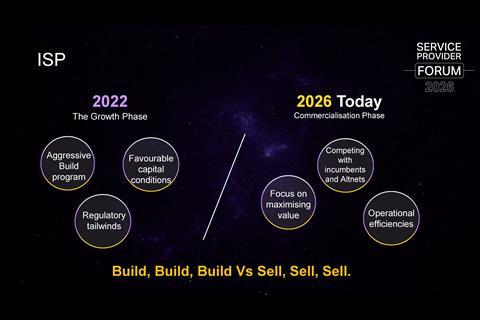
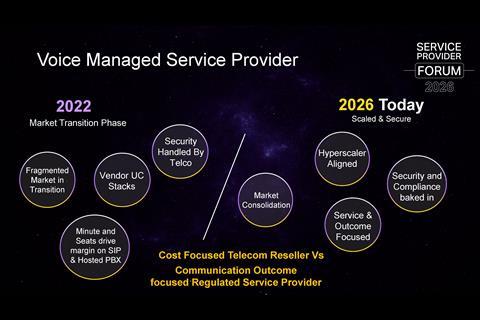
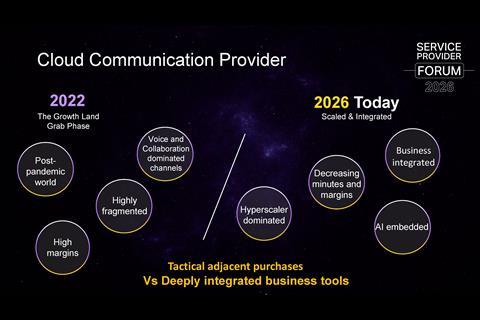
In the past few years, ISPs have moved from a growth phase to one of commercialisation, cloud communication providers (CP) have evolved from land-grab to scale and integration, and voice managed service providers (SP) have tilted from a post-pandemic market fillip to pursuing scale and stability.

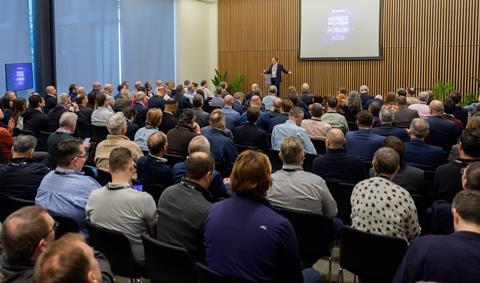
For many in these three self-defining segments that constitute the client base of Gamma Communications’ Service Provider division, the next evolution is international as well as portfolio expansion, according to Gamma’s Managing Director for SPs, Mike Mills.
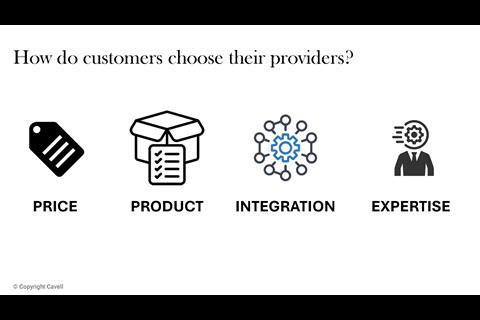
Speaking at this year’s Gamma Service Provider Forum, he tracked four years of evolution within his client base, concluding that SPs “are at an inflection point” where monetising assets, adding value, and commercialisation are the priorities. This translates to a shift away from a product- and price-led environment into a world where the focus is on achieving business value outcomes for customers.
Entering new portfolio segments and geographic markets answers some of these demands, with the latter also informing Gamma’s own decision to make a ‘global’ play of its own.
Following a year of outreach and consultation, including meeting hundreds of customers and establishing a Partner Advisory Board, Mills and his team are confident that SPs are seeing major opportunity in overseas expansion, and also need a partner of sufficient scale and expertise to help navigate the heightened exposure to regulatory, compliance, and technological stresses.
Your next stop: Sydney, Manila, Singapore, Wellington…
This view informed Gamma’s decision this year to launch into multiple high-growth Asia-Pacific markets, adding to the London-based communications platforms enabler’s UK and Germany core and Europe region hinterland.
“ The reason we want to go global is we think there’s a massive opportunity for the kind of things that we do, the kind of things that you do, the kind of things that you’re specialising, the kind of things that we’re specialising. You know, Big G [Gamma’s mascot] in that trust equation is about ‘we won’t let you down: we will be secure, reliable, we’ll put support where you need it’. ”
Chris Wade, Chief Marketing & Product Officer, Gamma.

Gamma now has boots on the ground in Australia and the Philippines, having gone live with the first in January, and New Zealand and Singapore upcoming. This has also elevated global services and network support to truly 24/7 operations and support. With the new local and regional expertise in APAC, Mills says Gamma can now shoulder the regulatory and compliance burden for SPs, enabling them to focus on essential and fundamental “portfolio diversification, increased automation, and globalisation”.
While global expansion is pitched towards voice managed SP clients, Gamma guides its cloud communication SP cohort towards portfolio diversification, including its own UCaaS, mobile, security, IoT, and international solutions. For more domestically-minded clients, notably altnets and ISPs facing intensified competition, the addition of voice and MVNO is promoted to build out a broader, stickier, and more differentiated multiplay proposition, with London’s Community Fibre on stage as a flagbearer for this approach.

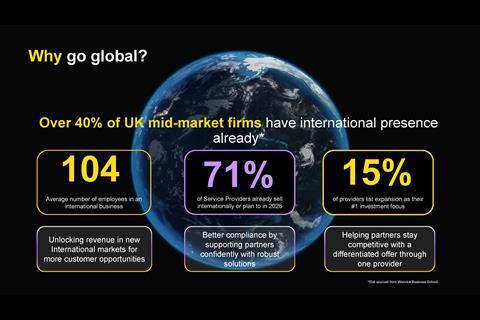
Adrian Williams, Gamma’s Channel Director, cited data from Warwick Business School to demonstrate that a large proportion of UK mid-market businesses already have an international presence of some kind (with WBS guiding that around two-third export and international sales equating to about 34% of revenue), and from Cavell that 71% of SPs plan to be selling internationally this year (with 15% deeming it their top investment priority). “There lies the opportunity for us to capitalise”, he said. “The sweet spot for international is clearly in SME”.
APAC ticks the boxes
David Williams, Commercial Director, said Gamma’s acquisition of international SMS and voice services provider Coolwave, in early 2024, granted an early look at international markets and showed Gamma that it must have an “educated understanding” of markets, with local expertise, before moving in. He said that part of this process has been to recognise that, although Gamma “could go and do things at scale in a market, in many cases it just wasn’t sensible”.

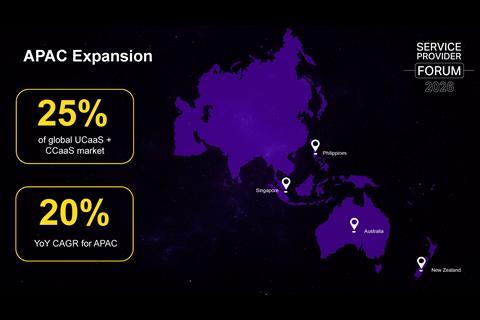
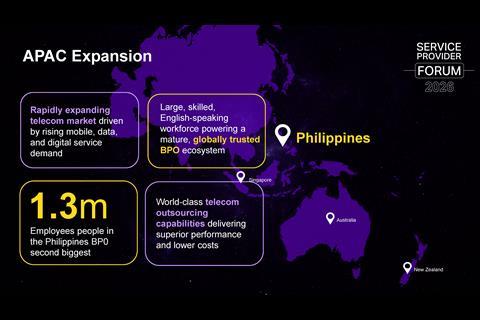
APAC was chosen for both its perceived standout growth opportunity and relevance from a UCaaS and CCaaS perspective (the region is estimated to represent around 25% of global seats, with 20% CAGR, according to analysts at Cavell). The Philippines, for example, is a significant global business process outsourcing (BPO) market, with a good level of English-speaking expertise. “There’s a lot of history there”, Adrian Williams noted, with around 1.3 million people working in BPO in the country, which is considered second only to India in this market segment worldwide. Singapore is a global strategic hub, geographically and economically, while Australia (and New Zealand) is not just “accessible” on the language front, but also a market of significant scale in its own right. Williams said the region is also attractive because, owing to its complexity, market entrances are “not typically done well”, giving both Gamma and its SP clients an edge and differentiation.
“ The economic growth in that [APAC] territory is massive on the global level, and just look at the number of users in that region — it really is impressive when you couple that with the growth and the complexity of getting into there. There are only a few that will be able to access that market, but then [to] access that market and provide the service level that is expected, and the compliance… that is what we’re looking to provide. ”
Williams.
No interloper: solving problems without owning the SP’s customers
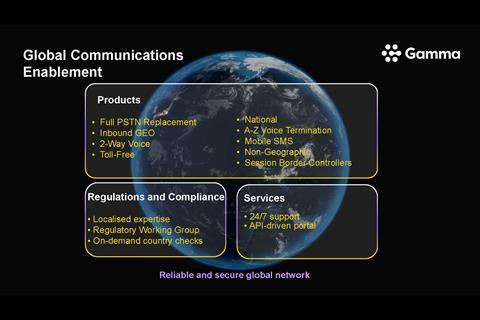
The Gamma SP proposition encompasses voice, full PSTN replacement, numbering services, A-Z voice termination, and more, managed through an API-driven platform.
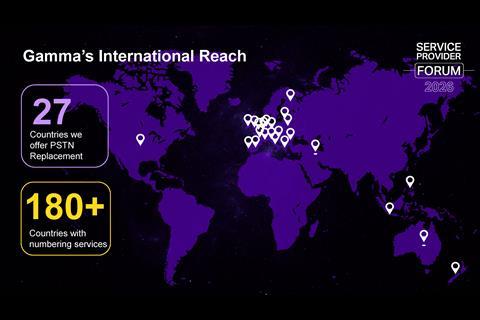
The full new Global Communications Enablement (GCE) offering is currently available in 27 countries, with broader capabilities in over 180 territories. GCE marks immense multi-year effort and investment, and not just network and systems, with PSTN replacement, for example, added for a further 20-plus countries since last year. As with other products and services, this builds on offerings in the group’s core markets, with an added layer of support in regulation and compliance via localised expertise.
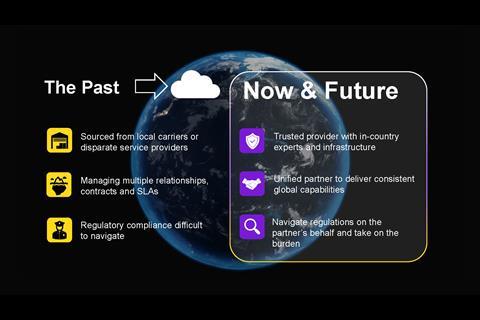
While the traditional approach of effectively handing over ownership of client relationships to a local player helped navigate the risks of an SP’s expansion into new markets, Mills considers the Gamma mindset of “solve the problem, but let the partner retain maximum ownership” to be greatly superior. This sees Gamma acts as the regulated provider in a geography, but without any need to come into direct contact with an SP’s end-customer.
“ The reason I think we’re different is, for us, [SPs] retaining ownership of the client is absolutely fundamental. There are a few operators out there that take a kind of ‘dealer’ or ‘customer ownership’ view on it. Ours is different: we actually want to own as little of that contract as possible. ”
Mills.
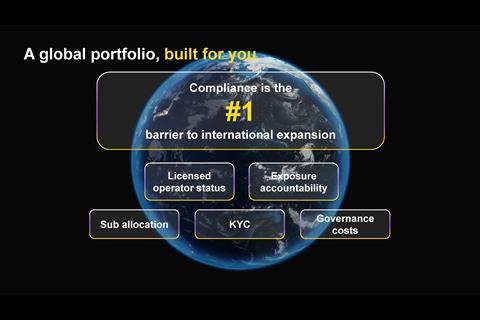
Adrian Williams further explored how Gamma is working to “release [SPs] from that burden”, citing compliance as the number-one challenge. Gamma aims to address this massive resource, cost and risk overhead of wading through constantly shifting complexity, inconsistency, red tape, local nuances, and juggling multiple partners — by providing one-touch global-local presence and nodes managed via the cloud. Gamma is also open to adding new geographies, based on SP client demand.
“ We look to potentially provide you with a unified partner experience [internationally]. You’ll have consistent SLAs, consistent communication, one place to go to the information that you need, and then from a regulatory point of view we’ll provide you the ability to release yourself from the burden of trying to manage that. We have the economies of scale that we need to be in those markets. ”
Adrian Williams.

Tracking four years of SP evolution — and primed for the next stage
Wade said the international expansion is evidence of Gamma’s aspiration to “grow and evolve and develop” with SPs.
Gamma’s SP ‘diversification, automation, and globalisation’ strapline has been informed by the journey taken by its customers over the past four years, as laid out by Mills:
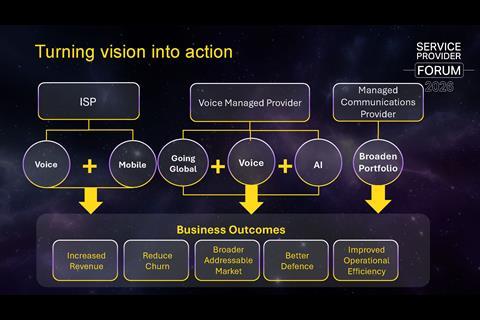
- In 2022, ISPs were focused on aggressive build, funded by relatively cheap financing and support from investors and government “chucking billions of pounds” at build programmes, said Mills. In 2026, “that’s fundamentally shifted”. The drive is now on maximising value, competing with incumbents and overbuilding altnets — “it’s all about being as efficient as you can”. For this segment, Gamma guides towards adding voice and mobile to make fibre connectivity a more differentiated bundled offering, and majorly drive up ARPU.
- For cloud communication providers, 2022 saw a continuation of the pandemic wave of video, voice, and collaboration tools, in a fragmented market. Now, Mills considers the market “hyperscaler-dominated”, with the likes of Cisco, Microsoft, and Zoom taking a disproportionate share of the market as customers demand AI-embedded, business-integrated solutions. For this group, Gamma seeks “to give you the broadest portfolio you’ve ever had, to drive as much value out of the customer bases that you’ve got”.
- The story is similar for managed voice SPs, which have seen a shift from a fragmented market “reliant on vendor stacks”, with UCaaS only beginning to emerge, to a “massively consolidated” market with hyperscaler alignment “pretty much everywhere”, and demand from customers for security and compliance to be baked into every product and service. To address this, Gamma points to a future that both goes global and draws on market demand for AI-enablement, “to really drive that stickier, higher revenue business model for you”.
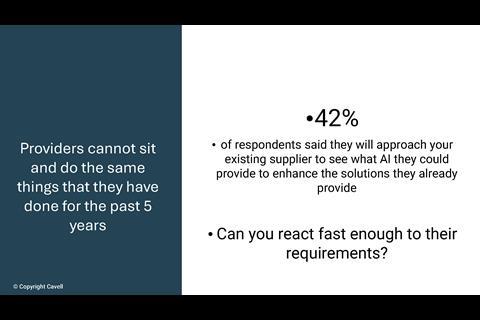
In laying out the harsh realities that have emerged from five years of market evolution, Gamma makes the argument that inertia is not an option.
“ What you’ve ended up with [in 2026] is a real requirement to go from a cost-focused reseller to a compliant, regulated provider, delivering a business outcome.
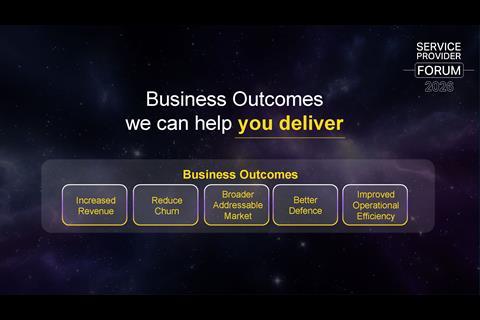
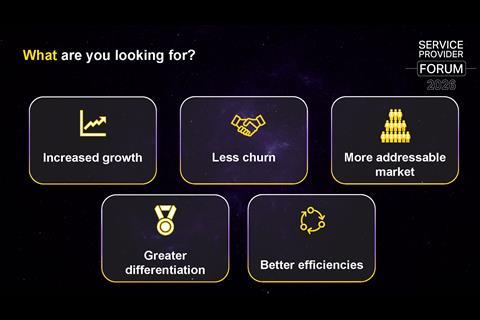
With all these challenges, there’s a monumental opportunity for service providers, and we want to be there to power your growth by delivering on the key valuable business outcomes that we came to when we spoke to you and spent time with you. And principally, it’s how do I increase my revenue? How do I reduce churn? How do I increase the addressable market that I serve, give me better defence, help me protect what I’ve got, and make me more efficient, help me drive operational efficiencies. ”Mills.
As MD for Service Providers, Mike Mills is responsible for all aspects of Gamma’s relationship with SPs, network operators, and MVNO partners.
Aside from laying out Gamma’s priorities (“where we’re going in 2026 and beyond”) and presenting clients with “concrete actions you can take away for your business to allow you to grow and succeed in 2026 and beyond”, Mills’ third objective at the Service Provider Forum was “thought-provoking thought leadership and insight”. Along with Gamma’s own insights, this included hosting analysts Andrew Collinson and Dominic Black, with AI Voice a core theme for both, not just because of forecast potential and opportunity, but also because businesses are already actively seeking AI capabilities and outcomes.

Connective Insight’s Collinson explored prospects for voice revenue, identifying significant scope for growth, often tied to AI and network intelligence. He looked to the US as a pathfinder, where research suggests the majority of enterprises are already capturing (and increasingly transcribing) voice data, and increasing related spend (with a significant 15% already developing AI Voice agents) in the expectation that voicetech will drive growth and operational effectiveness. AI Voice is apparently already considered to be ‘foundational’, ‘transformational’ and to be an ’accelerant’ for US corporations. Collinson perceives AI Voice-related opportunities around APIs, network intelligence, verticalised and SME offerings, secure and compliant frameworks, and analytics — guesstimating $10bn–$15bn in potential new revenue by 2030.

Cavell’s Black echoed Gamma’s Mills in noting dramatic market changes this decade, but in this case for technology buyers now demanding better solutions and services, new functionality, and business continuity — as well as lower prices (44% SPs have apparently seen squeezed ARPU and AMPU). AI is said to have the highest priority for larger businesses (ranking second for smaller ones), with enhanced cybersecurity and compliance close behind. Cost reduction and improving customer services are also notable priorities. Cavell sees the UCaaS segment maturing in the UK, albeit still with another leg through 2030 offering up 1.7 million new SME users and 21.1 million users up for renewal. To navigate market pressures, diversification and innovation are placed top of the list for SPs. Areas identified as currently in demand for SPs are security, contact centre, CRM, and access connectivity, with messaging services, native fixed-mobile integration, IoT, and voice-enablement for Zoom seeing momentum. AI is said to be everywhere, in terms of platforms, and SPs may need to keep up with customers actively investigating capabilities. The call centre market is also in flux, with on-premises agents looking squeezed (halving to less than 20%) between cloud-provisioning and ‘AI-offset’ (doubling to over 20%). Awkwardly, consumers do not yet seem AI-enamoured, with 49% apparently seeking human contact (and in-country). Another aspect of AI’s surge is demand for data security, compliance, upskilling, and enhanced infrastructure. Particular threats to SPs are suggested to include AI-native platforms, CRMs embedding voice, and existing rivals and vendors becoming more assertive, while moves to verticalisation can also be interpreted as an opportunity.




Topics
- Adrian William
- AI/GenAI/ML (artificial intelligence, agentic, machine learning)
- Asia-Pacific (APAC)
- Australia
- Channel/Indirect/Partner sales (sell-with/through)
- Chris Wade
- Cisco
- Cloud (IaaS/PaaS/SaaS)
- Community Fibre
- Contact centre
- David Williams
- Europe
- Gamma Communications
- Germany
- IoT (Internet of Things, M2M)
- Legal (compliance, regulatory)
- Microsoft
- Mike Mills
- MVNO (MVNE/MVNA)
- Partnerships & Alliances
- Products & Services
- Security
- Service Provider vertical
- Singapore
- Strategy & Change
- Thought Leadership
- Unified Communications (UCaaS)
- United Kingdom (UK)
- USA
- Voice